Here is an answer you might not expect from a dental clinic: if your old silver fillings are sound, sealed and symptom-free, you usually should not rush to replace them. That is not just our view at Bull Creek Dental — it reflects the position of the Australian Dental Association, which advises against removing amalgam purely for non-specific health concerns. Sound old fillings are still doing their job.
So why do so many patients in Leeming ask about swapping silver for white? Partly appearance, partly headlines about mercury, and partly genuine wear and tear — because no filling lasts forever. This guide separates the myths from the real reasons to replace amalgam, so your decision about dental fillings is based on evidence rather than marketing.
If you’d like your old fillings assessed, book your appointment today or call 08 9332 3608.
Are Silver Amalgam Fillings Safe?
For the vast majority of people, yes. Amalgam has been used for well over a century, and the ADA’s current policy on dental amalgam states that extensive research shows it is a durable, safe and effective restorative material, with no established link between amalgam fillings and chronic disease in the general population. The recognised exceptions are people with a proven allergy to amalgam components or severe kidney disease, and dentists are advised to minimise its use in children and in women who are pregnant or breastfeeding.
What has changed is the environmental picture, not the safety one. Following the Minamata Convention on Mercury, nations agreed in late 2025 to end the manufacture, import and export of dental amalgam from 2034. That decision is about reducing mercury in the environment — it does not mean fillings already in your mouth are dangerous, and it creates no requirement to remove them.
Why Dentists Don’t Recommend Replacing Sound Amalgam
Replacing a healthy filling is not a neutral swap. Every time a filling is removed:
- Some additional healthy tooth structure is usually lost, making the cavity slightly larger each time
- The tooth’s nerve experiences another round of drilling, with a small cumulative risk of sensitivity or, rarely, needing root canal treatment down the track
- Removing amalgam actually releases more mercury vapour in that moment than leaving it undisturbed would
In short: a well-sealed amalgam that shows no decay, no cracks and no leakage is often the most conservative option you have. We’d rather monitor it at your regular check-up than drill for the sake of it.
When Replacing an Old Silver Filling IS the Right Call
Amalgam is tough, but decades of chewing take a toll. We recommend replacement when we find:
- Decay underneath or beside the filling — visible on examination or X-ray, and the most common genuine reason for replacement
- Cracked or crumbling margins — gaps around the edge let bacteria seep beneath the filling where your toothbrush cannot reach
- A cracked tooth around a large amalgam — big, old silver fillings act like a wedge; hairline cracks in the surrounding tooth can grow until a cusp fractures
- Repeated sensitivity or pain on biting — often the first sign that a filling is leaking or the tooth beneath is cracking
- A conscious cosmetic choice — if a visible silver filling bothers you every time you smile, replacement is reasonable once you understand the trade-offs. That’s an informed choice, and we’ll support it
What You Get With Modern White Fillings
Composite resin fillings have improved enormously. Today’s materials bond directly to the tooth, which means we can often remove less structure than amalgam preparation required, and the bond helps hold weakened cusps together rather than wedging them apart. They are colour-matched to your tooth, set instantly under light, and handle everyday chewing forces well. For very large cavities where little natural tooth remains, we may recommend a porcelain crown or onlay instead, because a filling — white or silver — can only do so much when most of the tooth is gone.
White vs Silver: How the Materials Actually Compare
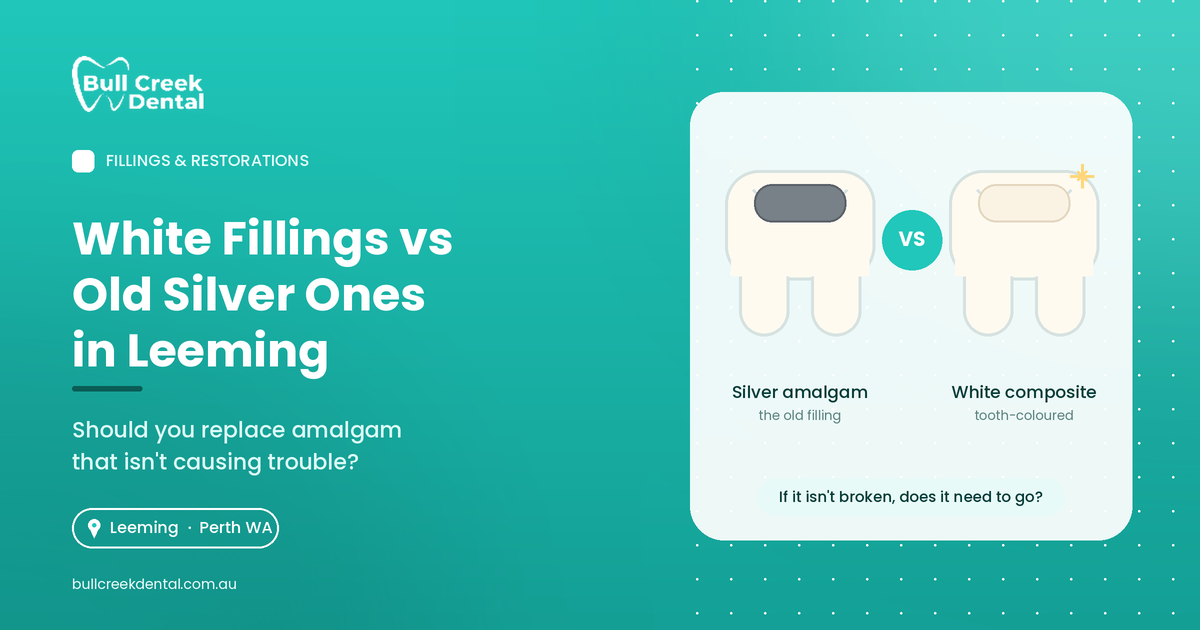
- Appearance: composite is colour-matched and effectively invisible; amalgam darkens over time and can grey the surrounding tooth
- Tooth preservation: composite bonds to enamel, so less healthy tooth is drilled away; amalgam needs mechanical undercuts to lock it in place
- Durability: amalgam still has the edge for sheer longevity in large back-tooth fillings — many last 15 to 20 years — while composite typically manages 7 to 10, though modern materials keep closing the gap
- Structural effect: bonded composite helps splint weakened cusps together; a large amalgam can act as a wedge that stresses them apart
- Repairability: a chipped composite can often be patched in one visit without removing the whole filling — something amalgam rarely allows
- Sensitivity of placement: composite must be placed in a dry field with careful technique, which is why an experienced clinician matters more with white fillings than silver ones
Signs an Old Amalgam Is Starting to Fail — What to Watch Between Visits
You don’t need to wait for a check-up to notice trouble brewing. Between visits, keep an eye — and a tongue — out for: a rough or sharp edge where the filling meets the tooth; food or floss catching in a spot that used to be smooth; a grey or dark shadow spreading in the tooth around the filling; new sensitivity to cold, sweet or biting pressure on a previously quiet tooth; or a piece of filling that simply feels different. None of these guarantees the filling has failed, but each is a reason to have it looked at sooner rather than later — small margin problems are a simple filling to fix, while a cusp fracture on a neglected one can mean a crown or worse.
What Replacement Involves at Bull Creek Dental
If we agree a filling needs replacing, the appointment is straightforward: local anaesthetic, careful removal of the old amalgam under high-volume suction and water spray, removal of any decay, then bonding and sculpting of the new composite — usually all in a single visit. As a local practice serving Leeming, Willetton, Brentwood and Bull Creek, we’re open six days a week with complimentary parking, and Healthdirect’s dental care guidance is a good independent resource if you’d like to read more before your visit.
On cost: replacement fillings sit in the general restorative category of most extras policies, so health fund members typically receive a partial rebate — claimable on the spot through HICAPS at our practice — and our payment plan options, including Afterpay, Zip and Humm, can spread any gap. Eligible children may also be covered under the Child Dental Benefits Schedule. We’ll always give you the item numbers and a written quote before treatment, so you can confirm your rebate with your fund and decide with the full picture in front of you.
Not sure whether that old silver filling is fine or failing? Book your appointment today, contact us online or call 08 9332 3608.
Frequently Asked Questions
Should you replace amalgam fillings that aren’t causing problems?
Usually not. Australian dental guidance advises against removing sound amalgam for non-specific health concerns, because removal sacrifices healthy tooth structure and briefly increases mercury exposure. Replacement is recommended when there’s decay, cracking, leakage — or a considered cosmetic preference.
Are silver fillings being banned in Australia?
Existing fillings are not banned and never need removal for regulatory reasons. Under the Minamata Convention, the manufacture, import and export of new amalgam ends globally from 2034, and Australian dentists are already phasing down its use — mostly in favour of composite resin.
How long do white composite fillings last?
Typically around 7 to 10 years, and often longer with good oral hygiene, though large fillings under heavy chewing forces wear sooner. Regular check-ups let us catch wear early, when repair is simple.
Does removing an amalgam filling damage the tooth?
Careful removal is safe, but each replacement enlarges the cavity slightly and re-stresses the nerve — which is precisely why we don’t replace fillings without a clinical or considered cosmetic reason