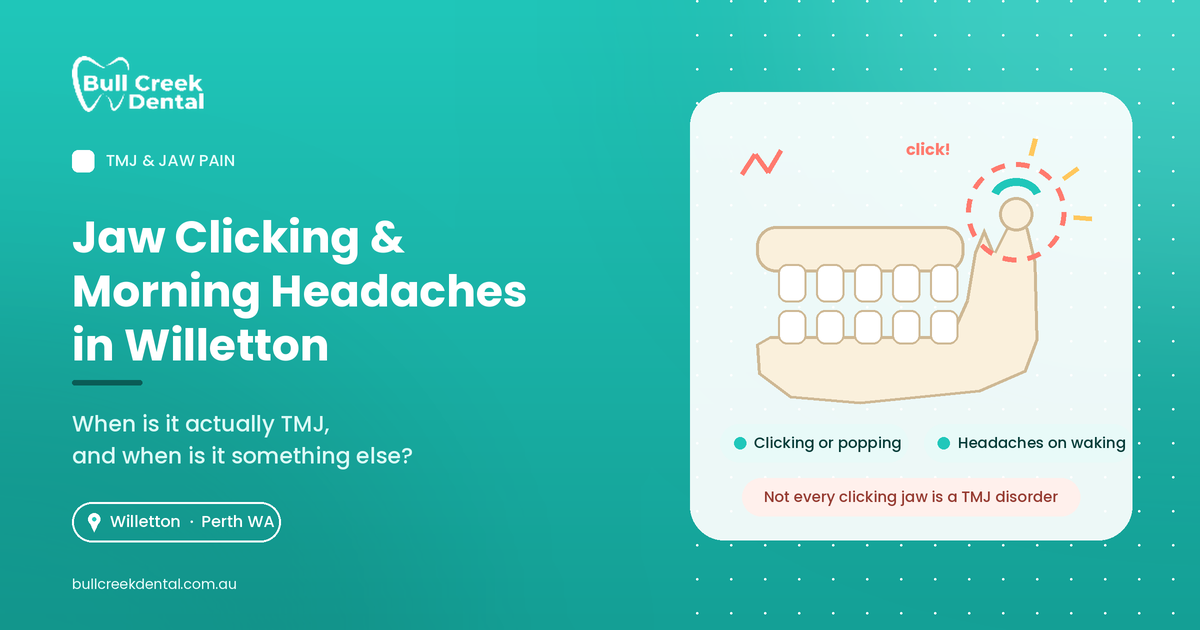
Your jaw clicks when you yawn. You wake up most mornings with a dull headache around your temples. Is that TMJ — or just one of those things? The honest answer: a clicking jaw on its own, without pain or restriction, is common and often harmless. But clicking combined with morning headaches, facial soreness or a jaw that feels tired before breakfast is a pattern worth taking seriously, because it usually points to a temporomandibular joint (TMJ) disorder, night-time clenching, or both.
At Bull Creek Dental, we provide TMJ treatment for patients across Willetton and Perth’s southern suburbs, and the first step is always the same: working out whether your symptoms genuinely come from the jaw joint at all. This guide walks through how we tell.
If your jaw is already painful or locking, don’t wait — book your appointment today or call 08 9332 3608.
What Is the TMJ — and What Does ‘TMD’ Mean?
The temporomandibular joints sit just in front of each ear, connecting your lower jaw to your skull. Each contains a small cartilage disc that cushions the joint as it hinges and slides — thousands of times a day, every time you chew, speak, swallow or yawn. When the joint, disc or surrounding muscles stop working smoothly, the resulting group of conditions is called temporomandibular disorder (TMD) — what most people simply call “TMJ”.
Why Does a Jaw Click?
The classic click happens when the cartilage disc slips slightly out of position, and the jaw pops over it as you open or close. Other causes include ligament laxity, past jaw injury, arthritis in the joint, and muscle tension pulling the joint out of its comfortable path. Healthdirect notes that clicking without pain generally doesn’t need treatment — the key question is what comes with it.
Harmless Click or Real Problem? The Signs That Separate Them
Clicking alone, with full comfortable movement, can simply be monitored. We recommend an assessment when clicking comes with any of the following:
- Morning headaches or temple soreness — frequently a sign of overnight clenching or grinding, loading the joint and muscles for hours
- Pain or aching in the jaw, face or around the ear, especially while chewing
- Jaw stiffness on waking or a jaw that tires quickly during meals
- Locking — the jaw catching open or refusing to open fully; this warrants prompt review
- A change in how your teeth meet, or unexplained wear, chips and cracked fillings
The Morning Headache Connection: TMJ and Clenching Overlap
Here is the piece most people miss: morning headaches with a clicking jaw are very often not a joint problem alone but a muscle problem — driven by bruxism (grinding) or clenching during sleep. Hours of overnight muscle contraction inflame the chewing muscles that wrap the temples and jaw, and you wake already aching. Because grinding also strains the joint itself, the two conditions feed each other — which is why treating the night-time habit frequently settles the headaches, the clicking and the facial soreness together.
Is It a Dental Problem or a Medical One?
Sometimes neither the joint nor the muscles are the culprit. Ear infections, sinus congestion, dental infections, wisdom teeth and migraine can all mimic TMJ symptoms. Part of our assessment is ruling these out — checking your teeth and bite, palpating the joint and muscles, measuring your jaw’s range of movement and taking X-rays where needed. If findings suggest a medical cause, we’ll refer you to your GP; Cleveland Clinic’s TMJ resources are also a reliable independent reference on the condition.
What You Can Do at Home Before Your Appointment
If your jaw is aching now, these simple measures often take the edge off while you wait to be seen:
- Rest the joint: choose softer foods for a week or two, cut food smaller, and avoid chewing gum, crusty bread and very chewy meat
- Mind the yawn: support your chin with a fist when yawning to stop the jaw opening to its extreme
- Warmth for muscles: a heat pack over the jaw and temple muscles for 10–15 minutes eases the deep ache of overworked muscles; some people prefer brief cold for a sharply painful joint
- Watch daytime habits: notice clenching at your desk or in traffic — lips together, teeth apart is the resting position to aim for
- Short-term pain relief: over-the-counter analgesia can help in the short term; your pharmacist or GP can advise what suits you
These measures manage symptoms — they don’t diagnose the cause. If pain persists beyond a couple of weeks, or you get locking or morning headaches, it’s time for an assessment.
What Happens at a TMJ Assessment
A TMJ assessment at Bull Creek Dental is unhurried and methodical. We listen to your history first — when the clicking started, what makes it worse, how you sleep, your stress picture — because the story often points to the cause before we touch anything. Then we examine: feeling both joints as you open and close, measuring how wide you can open and whether the jaw deviates, palpating the chewing muscles at the temples, cheeks and under the jaw for tenderness, and checking your teeth for the tell-tale wear facets, cracks and scalloped tongue edges of night-time grinding. X-rays are taken where the joint itself needs a closer look. By the end you’ll know whether this is a joint problem, a muscle problem, both — or something else entirely.
Can TMJ Go Away on Its Own — and What Does a Dentist Actually Do?
Often, yes — many TMD flare-ups settle within weeks with conservative care: softer foods for a period, avoiding extreme jaw opening, gentle stretches, heat packs and stress management. When symptoms persist or clenching is driving them, the mainstay of dental treatment is a custom occlusal splint worn at night to decompress the joint and stop the grinding forces reaching your teeth. What we don’t do is rush anyone toward irreversible treatment — surgery is a last resort for a small minority of cases, and evidence strongly favours conservative management first. Our Willetton patients can reach us six days a week, minutes away in Bull Creek, with complimentary parking at the door.
One reassuring note to finish on: TMD is very rarely a condition that ruins jaws. For most people it’s cyclical — flaring in stressful seasons, settling in calmer ones — and the goal of treatment is to shorten the flares, protect your teeth and joints while they happen, and give you the tools to manage the next one early. A well-made splint reviewed at your regular check-ups, a few habit changes and knowing your own warning signs are usually all it takes to keep the condition firmly in the background of your life rather than the foreground.
Waking with headaches or a clicking, aching jaw? Book your appointment today, contact us online or call 08 9332 3608.
Frequently Asked Questions
What causes a clicking jaw?
Most commonly, the cartilage disc inside the jaw joint slips slightly out of position, so the jaw pops over it during movement. Injury, arthritis, ligament laxity and muscle tension from clenching can also cause it. Painless clicking is usually harmless; painful clicking deserves assessment.
Can TMJ go away on its own?
Many episodes settle within weeks using conservative measures — softer foods, jaw rest, heat and stress management. If pain, locking or morning headaches persist, a dental assessment and a custom night splint are the usual next steps.
Is jaw pain a dental problem or a medical one?
It can be either. Tooth infections, wisdom teeth, clenching and joint problems are dental; ear infections, sinusitis and migraine are medical mimics. A dentist can examine the joint, muscles and teeth, and refer you to a GP if the cause isn’t dental.
What does a dentist do for TMJ pain?
Assessment of the joint, muscles and bite first, then conservative treatment — typically a custom occlusal splint for night-time clenching, plus habit and lifestyle advice. Irreversible options like surgery are reserved for the small minority of cases that don’t respond.