“No gap” is one of the most appealing — and most misunderstood — phrases in Australian dental care. It does not mean everything at the dentist is free. It means that for certain services, at certain practices, on certain levels of cover, your health fund’s benefit equals the full fee, so you pay nothing out of pocket. Understanding exactly where those boundaries sit is the difference between walking out delighted and walking out surprised.
As a preferred provider practice, Bull Creek Dental works with major funds including HBF, HCF, nib, CBHS and smile.com.au, and sees patients from Brentwood every week. Here’s a plain-English guide to what preferred provider status and no-gap dental genuinely cover — and where gaps typically appear.
Want to know your position before treatment? Book your appointment today or call 08 9332 3608 — bring your fund details and we’ll help you check.
What Does ‘Preferred Provider’ Actually Mean?
A preferred provider is a dentist who has an agreement with a health fund — HBF calls its network Member Plus, and other funds use names like “members’ choice”. Under the agreement, the practice charges fund members according to the fund’s fee schedule for eligible services, and in return the fund pays higher, more predictable rebates at that practice. Two things it does not mean: it doesn’t restrict which dentist you may see (you can attend any practice — the rebate simply differs), and it isn’t a fund’s judgement of clinical quality. It’s a fee arrangement.
What ‘No Gap’ Typically Covers
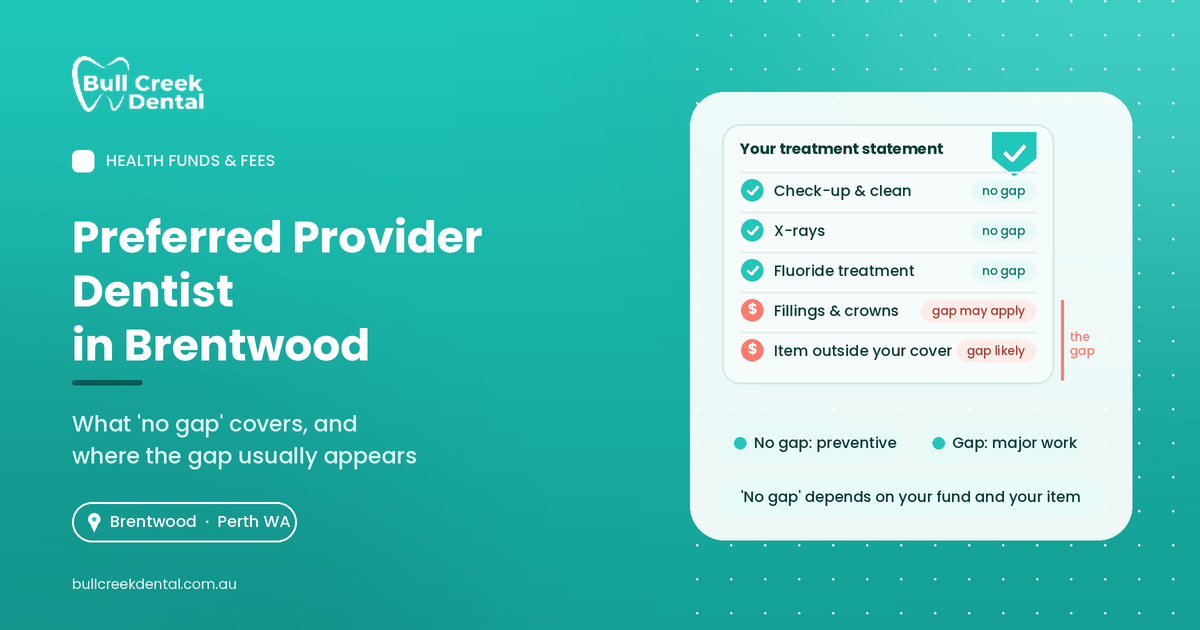
No-gap arrangements are built around preventive dentistry — the category funds most want to encourage, because prevention costs everyone less than repair. Depending on your fund and level of extras cover, no-gap or high-percentage-back services at a preferred provider commonly include:
- Routine examinations and check-ups
- Scale and cleans — HBF, for example, offers eligible members 100% back on their first scale and clean each calendar year, and 50–100% back on preventive services depending on cover level
- Standard X-rays taken as part of your check-up
- Fluoride treatments
- Custom-fitted mouthguards on many policies
The highest extras tiers may offer a full no-gap experience across preventive services at network practices — always up to your policy’s annual limits.
Where the Gap Usually Appears
This is the part most blogs skip. Out-of-pocket costs generally arise from five places:
- Category, not clinic: fillings and extractions sit in general restorative, and crowns, root canal therapy, dentures and implants in major dental. Funds pay fixed benefits toward these — rarely the full fee — so a gap is normal even at a preferred provider
- Annual limits: once your extras limit for the year is used, further treatment is fully out of pocket until limits reset — commonly on 1 January, though some funds differ
- Waiting periods: new policies and upgrades typically carry waits — often around 2 months for general dental and 12 months for major dental — and treatment during a wait attracts no benefit at all
- Level of cover: basic extras may rebate 50–60% of preventive fees rather than 100%, and may exclude major dental entirely
- Non-covered items: purely cosmetic treatments, like teeth whitening, generally attract no rebate on any policy
Independent information on how extras policies work is available at the Australian Government’s privatehealth.gov.au, and your fund — for HBF members, hbf.com.au — can confirm your exact cover, limits and waiting periods.
A Worked Example: Where the Same Patient Pays Nothing — and Where They Don’t
Picture a Brentwood patient with mid-to-high extras cover attending a preferred provider practice. Their routine visit — examination, scale and clean, two check-up X-rays and fluoride — falls entirely within preventive dental: the fund’s benefit covers the scheduled fee, HICAPS processes it on the spot, and they pay nothing. Six months later the same patient cracks a molar and needs a crown. Crowns sit in major dental, where the fund pays a fixed benefit — say a few hundred dollars against a fee of well over a thousand — so this time there is a genuine gap, and if their major dental annual limit is partly used, the gap grows. Same patient, same practice, same fund: the difference was never the clinic, it was the category of treatment. That’s the single most useful thing to understand about extras cover.
Three Preferred Provider Myths Worth Clearing Up
- “I’m locked into network dentists.” No — you can see any dentist you like. At a non-network practice your rebate is simply calculated differently and is usually lower, with a larger or less predictable gap
- “Preferred means the fund rates them as better dentists.” Preferred provider status is a fee agreement, not a quality award. Choose your dentist on care, experience and trust — the network status affects your wallet, not your treatment
- “No gap means my whole visit is free.” No gap applies to specific eligible services — overwhelmingly preventive ones — on eligible covers, within limits. Anything outside that scope attracts normal benefits and a normal gap
How to Avoid Gap Surprises Entirely
- Ask for item numbers first: before any non-routine treatment, we can give you the exact ADA item numbers and fees on a written quote
- Phone your fund with those numbers: they’ll tell you the precise rebate and your remaining limit — turning an estimate into a known figure
- Time larger treatment thoughtfully: if your annual limit is nearly used, staging treatment across the limit reset can halve your out-of-pocket cost
- Claim on the spot: with HICAPS at the practice, your rebate is processed immediately, and you pay only the gap — no paperwork, no waiting for reimbursement
- Ask about payment options for the rest: for larger gaps, our payment plan options include Afterpay, Zip, Humm, TLC and SuperCare
Making the Most of Your Extras in Brentwood
The simplest way to get value from extras cover is also the best thing for your teeth: use your preventive benefits fully. Two rebated check-ups and cleans a year cost many members nothing out of pocket at a preferred provider and catch problems while they’re small — before they graduate into major dental, where gaps live. Brentwood patients will find us minutes away in Bull Creek, open six days a week with complimentary parking and on-the-spot HICAPS claiming.
Extras cover isn’t the only help available, either. Eligible children can access up to around a thousand dollars of basic dental over two years through the Child Dental Benefits Schedule, veterans are supported under Department of Veterans’ Affairs arrangements, and eligible health care card holders may qualify for the Metropolitan Patients Dental Subsidy Scheme — all of which we process at the practice. If you’re unsure which of these applies to your family, ask when you book; five minutes on the phone regularly saves patients hundreds of dollars.
Unsure what your cover really gets you? Book your appointment today, contact us online or call 08 9332 3608.
Frequently Asked Questions
What does preferred provider mean at a dentist?
It means the practice has a fee agreement with a health fund — such as HBF’s Member Plus network — so members receive higher, more predictable rebates there, including no-gap preventive care on eligible covers. You’re always free to attend any dentist; only the rebate changes.
What does no gap dental actually include?
Typically preventive services: check-ups, scale and cleans, standard X-rays, fluoride and often mouthguards — up to your annual limits, on eligible levels of cover, at network practices. Restorative and major dental usually still involve a gap.
Can you claim dental on the spot at the practice?
Yes. With HICAPS, we process your health fund claim at reception the moment treatment is done — your fund’s rebate is applied instantly, and you pay only any remaining gap.
Do unused dental extras limits roll over each year?
With most funds, no — unused limits are lost when they reset, commonly on 1 January. A small number of policies offer rollover features, so check yours; if limits don’t roll over, booking your rebated check-up before the reset is money already paid for.