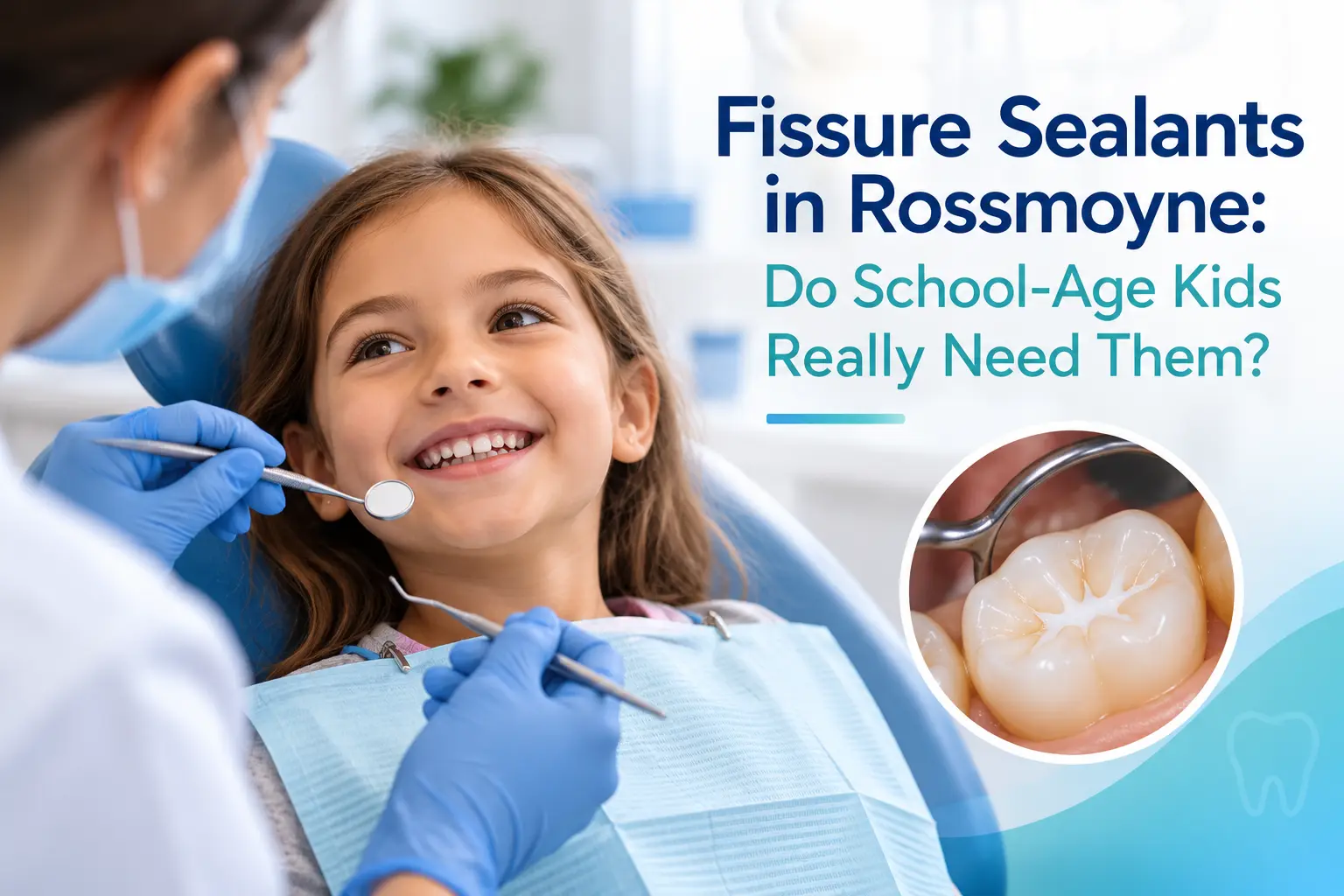
Somewhere around your child’s sixth birthday, quietly and without any wobbly-tooth fanfare, their first adult molars arrive at the back of the mouth. Nothing falls out to announce them; they simply appear behind the baby teeth, and they arrive with deep grooves on their chewing surfaces that a toothbrush bristle physically cannot reach the bottom of. Those grooves are where a large share of childhood cavities begin, and they are exactly what fissure sealants exist to protect.
If your dentist has suggested fissure sealants and you are wondering whether they are genuinely worthwhile or just an easy add-on, this guide is for you. We will give you the honest answer, which is more useful than a simple yes: many children benefit significantly, some do not need them at all, and the deciding factors are specific enough that Rossmoyne parents can understand them before anyone picks up an instrument.
Prefer to just have the molars looked at? Book your appointment today or call 08 9332 3608.
The Short Answer
Not every child needs fissure sealants, and any clinic that seals every molar on autopilot is overservicing. Healthdirect’s fissure sealant guidance says it plainly: not all children need them; they help most where grooves are deep. The decision is made tooth by tooth, based on how deep the grooves are, your child’s decay risk, and how well those particular teeth can be kept clean. For a child with deep, narrow fissures or a history of cavities, sealants are among the best-value prevention in dentistry. For a child with shallow, easily cleaned grooves and a low-sugar diet, they may add little, and we will say so.
What a Fissure Sealant Is (and What It Is Not)
A fissure sealant is a thin protective coating flowed into the grooves of a back tooth, where it sets hard and turns a deep, plaque-trapping crevice into a smooth, cleanable surface. It is not a filling; nothing is drilled, no needle is involved, and no tooth structure is removed. The whole process is painless and takes only a few minutes per tooth, which is why it fits easily into a normal children’s dentistry visit. Sealants have been used for roughly half a century, and the Australian Dental Association’s consumer guidance at teeth.org.au supports them as a safe, effective preventive measure for suitable teeth.
The Two Ages That Matter: Around 6 and Around 12
Adult molars arrive in two waves: first molars at roughly ages 5 to 7, and second molars at roughly 11 to 14. The window that matters is soon after each tooth erupts, because sealing works best on grooves that plaque has not yet colonised. Wait a few years, and the grooves may already show early staining or decay, at which point the conversation changes from sealing to monitoring or filling. Practically, this means two checkpoints for parents: a good look at the six-year molars in the early school years, and another at the twelve-year molars in early high school. Both fit naturally into routine check-ups, so no special appointment is needed to make the assessment.
Which Kids Benefit Most, and Which Can Skip Them
Here is the decision framework we actually use, so you can follow the reasoning in the chair:
- Strong case for sealing: deep, narrow grooves the probe catches in; any history of decay in baby teeth; a sweet-leaning diet or frequent snacking; brushing that is still more enthusiasm than technique; or teeth your child struggles to let anyone clean properly.
- Weaker case: shallow, self-cleansing grooves; a low decay risk overall; excellent brushing with fluoride toothpaste; and molars that have already been cavity-free for years.
- Changed case: a groove already showing early decay is managed differently, sometimes with a therapeutic sealant over the very earliest changes and sometimes with a small filling; sealing over established decay is never appropriate.
The honest summary: sealants are a per-tooth decision, not a package deal. It is completely normal for us to recommend sealing two molars and leaving the other two alone.
What the Appointment Feels Like for Your Child
The tooth is cleaned and dried, a preparation gel is applied and rinsed, the sealant is painted into the grooves, and a small blue light sets it hard; then we check the bite feels normal. There are no injections, no drilling, and no recovery, and most children find the blue light the most interesting part of their visit. For younger or wrigglier children, we can choose a faster-setting sealant material that tolerates a less-than-perfectly-dry tooth, which keeps the experience easy even for kids who find sitting still a challenge. Anxious little patients are our daily work; our earlier guide on helping kids with dental anxiety in Rossmoyne explains the gentler options if your child needs extra support.
What Sealants Do Not Do
Sealants protect only the chewing surfaces they cover. They do nothing for the surfaces between teeth, which is where floss earns its keep, and they do not make brushing optional. They also wear: chewing, grinding, and time can chip or thin a sealant over several years, so we check them at every check-up and top them up when needed, which takes moments. Think of sealants as one layer in a prevention stack alongside brushing with fluoride toothpaste, sensible snacking, and regular professional checks, a stack we covered for local families in our Rossmoyne children’s dentistry guide.
Cost, the CDBS, and Health Funds
In Australia, a fissure sealant typically costs somewhere in the range of $40 to $90 per tooth, which is a fraction of the cost of the filling it is designed to prevent. Better still for eligible families: fissure sealants are among the services covered under the Australian Government’s Child Dental Benefits Schedule, which funds basic dental care for eligible children aged 2 to 17, and we process CDBS claims at the practice with no out-of-pocket cost for covered services. For families using private extras cover instead, sealants sit in the preventive category; most funds rebate generously, and HICAPS claiming happens on the spot at reception. Either way, you will know the exact cost before anything touches a tooth.
Fissure Sealants Rossmoyne Families Can Rely On
School holidays are the natural moment to get this sorted, and plenty of Rossmoyne families fold a sealant check into the regular holiday check-up; the assessment adds minutes, not appointments. We examine each molar individually, show you the grooves we are worried about and the ones we are not, tell you plainly which teeth would benefit from sealing and which would not, and check CDBS eligibility while you are in the chair. Saturday mornings and Thursday evenings keep it workable around school and sport, and complimentary parking means the whole visit is genuinely quick.
Frequently Asked Questions
What are fissure sealants?
Thin protective coatings flowed into the deep grooves of back teeth, where they set hard and seal out food and bacteria. Application is painless, needle-free, and drill-free, taking a few minutes per tooth, and sealed grooves are far easier to keep clean with normal brushing.
Do all children need fissure sealants?
No. They are recommended tooth by tooth, based on groove depth, decay history, diet, and brushing. Children with deep grooves or higher decay risk benefit most; children with shallow grooves and low risk may not need them at all, and a good dentist will tell you which applies.
How long do fissure sealants last?
Several years is typical, though chewing and grinding gradually wear them. We inspect sealants at every routine check-up and repair or reapply them in minutes when needed, so protection continues through the high-risk childhood years.
Are fissure sealants covered by the Child Dental Benefits Schedule?
Yes. Fissure sealants are a covered service under the CDBS for eligible children aged 2 to 17, and we process claims at the practice with no out-of-pocket cost for covered services. Private extras cover also typically rebates sealants under preventive dental.
Book a Molar Check for Your Child
Bull Creek Dental, 1/79 Wheatley Dr, Bull Creek WA 6149, Australia | Get Directions
Phone: 08 9332 3608 | Book an Appointment | Contact Us
Open six days a week, with Thursday evening appointments, complimentary on-site parking, and on-the-spot HICAPS and CDBS claiming.