Dental anxiety is not one thing. There is the person who gets sweaty palms in the waiting room but manages fine once things start; the person who cancels twice before every appointment; and the person who has not sat in a dental chair for fifteen years and is reading this at 11pm with a toothache they have been ignoring for a month. Those are three different problems, and they deserve three different solutions, not one blanket offer of “don’t worry, we’re gentle.”
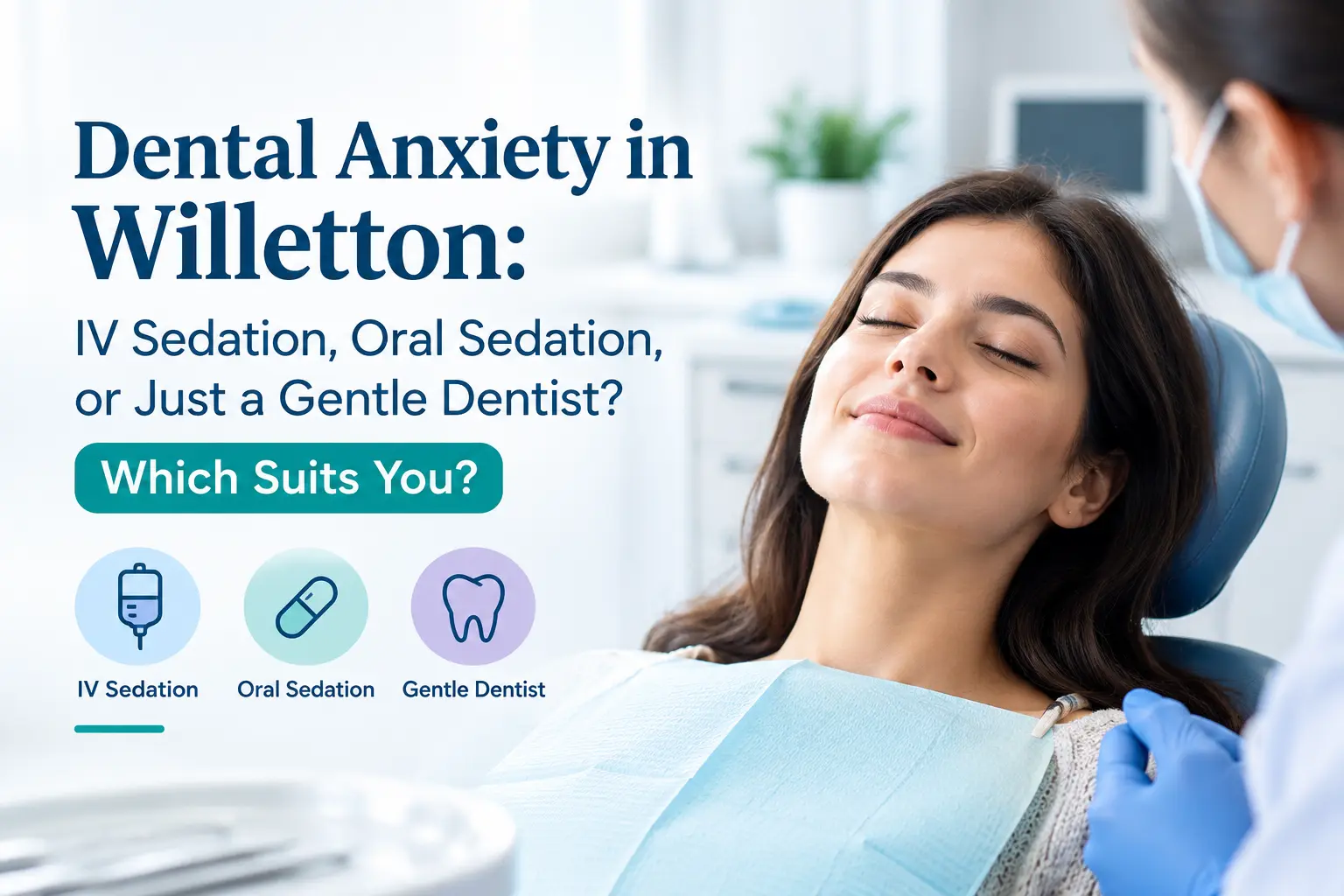
This guide is the matching exercise. We have written before about sedation dentistry in Willetton and about comfort options for anxious patients in general; this article does the thing those pieces did not: it lines up the three levels of help, gentle care, oral sedation, and IV sedation, against the three levels of anxiety, so you can find your row and know what to ask for.
Rather just talk it through with a human? Book your appointment today or call 08 9332 3608 and tell reception you’re nervous; it changes how we plan your visit, and you will not be the first caller that day to say it.
The Short Answer
Match the tool to the anxiety, not to the marketing. Mild nerves usually need no drugs at all, just a dentist who explains, pauses, and hands you control. Moderate anxiety, the cancel-and-rebook kind, often transforms with a single sedative tablet before the visit. Severe anxiety, phobia, or long procedures are where IV sedation earns its place, taking you to a drowsy twilight where the appointment passes with little or no memory. All three paths end at the same destination: treatment done, and confidence slowly rebuilt.
Level One: The Gentle Dentist Toolkit (No Drugs Involved)
For mild to moderate nerves, technique beats medication. What that looks like in our chairs: everything explained before it happens, never during a surprise; an agreed stop signal, usually a raised left hand, that we honour instantly and without negotiation; numbing gel before any injection, and slow, warmed anaesthetic so the injection itself is the non-event it should be; music or your own headphones if the sounds are the problem; and shorter first appointments that end on time, because trust is built by finishing when we said we would. None of this appears on an invoice, and for a large share of nervous patients it is the whole answer. Healthdirect lists exactly these communication-based approaches among the first-line strategies for dental anxiety.
Level Two: Oral Sedation (the Tablet That Takes the Edge Off)
For anxiety that talking cannot touch, oral sedation is the middle path: a prescribed sedative tablet taken before your appointment that leaves you awake, responsive, and profoundly more relaxed, often pleasantly indifferent to proceedings you would normally dread. You can answer questions and follow instructions; you simply stop caring about the drill’s soundtrack. The practical trade-offs: you cannot drive that day, so someone needs to bring you and take you home, and the level of sedation is less adjustable than IV, since the tablet’s effect is set once swallowed. It suits moderate anxiety, needle phobia mild enough to still allow local anaesthetic, and standard-length appointments.
Level Three: IV Sedation (Twilight, With the Dial in Our Hands)
For severe anxiety, dental phobia, strong gag reflexes, or long complex procedures, IV sedation, sometimes called sleep dentistry, changes everything. Sedative medication flows through a small cannula, taking you to a deeply relaxed twilight state; you are not unconscious as in a hospital general anaesthetic. You breathe on your own and can respond to voice, but time compresses and most patients remember almost nothing. Because the line stays in, the sedation depth is adjustable minute to minute, which is the key advantage over the tablet. The logistics are stricter: fasting beforehand, a responsible adult escort home, and the rest of the day off. For the fifteen-years-avoided patient, IV sedation is very often the bridge back, letting years of postponed work happen in one or two calm sessions instead of a dozen dreaded ones.
How We Choose With You (Not for You)
The decision comes down to four questions we will walk through at a no-treatment-first chat, which itself is a legitimate appointment type for anxious patients. How intense is the anxiety, honestly rated by you, not guessed by us? How long and complex is the treatment, since a twenty-minute filling and a two-hour surgical visit justify different measures? What do your medical history and medication list allow? And what do the logistics permit, since both sedation options need an escort and IV needs fasting and a free day? Cost scales with depth, and health fund rebates vary by policy, so you will have written figures before deciding. There is no prize for choosing less sedation than you need, and no judgement in choosing more; the only failure is another year of avoidance while a small problem grows into a complicated one.
The Part Nobody Advertises: You’ll Probably Need Less Each Time
Here is the pattern we see over and over. A patient arrives needing IV sedation for years of accumulated work. A visit or two later, they manage a filling with just the tablet. A year on, they are booking routine cleans with nothing but the gentle toolkit and their own headphones, mildly amazed at themselves. Sedation is not a lifelong dependency; used well, it is scaffolding. Every calm, pain-free visit quietly rewrites what your nervous system expects from a dental chair, and the anxiety that was built by bad experiences gets dismantled by good ones. The goal was never to sedate you forever; it was to break the avoidance cycle so ordinary dentistry could become ordinary again.
Sedation Dentistry Willetton Patients Can Actually Reach
Willetton is minutes from the practice, and the shortness of that drive matters more than it seems: anxious patients tell us the commute is where the dread builds, and a five-minute trip gives it no runway. Start wherever feels safe, even if that is a simple check-up and clean with the gentle toolkit and nothing else, and escalate only if and when you need to. Thursday evening and Saturday appointments help the anxiety that hides behind “I’m too busy,” and our Willetton patients page covers the practical details. Fifteen years of avoidance ends with one phone call that mentions the word nervous; we take it from there, at whatever pace you set.
Frequently Asked Questions
Will I be asleep with IV sedation at the dentist?
Not fully. IV sedation produces a deeply relaxed twilight state: you breathe on your own and can respond to voice, but time blurs and most patients remember little or nothing of the appointment. It is lighter and safer in a practice setting than a hospital general anaesthetic.
What is the difference between oral and IV sedation?
Oral sedation is a tablet taken before the visit that relaxes you at a fixed level; IV sedation is delivered through a cannula and can be adjusted minute to minute, reaching a deeper twilight state. Both require an escort home; IV also requires fasting and suits longer procedures and stronger anxiety.
Do I need someone to drive me home after dental sedation?
Yes, for both oral and IV sedation. A responsible adult must accompany you home, and you should not drive, work, or make important decisions for the rest of the day. Purely gentle, non-sedation care has no such restrictions.
What actually helps severe dental phobia?
A staged approach: a no-treatment first conversation, a dentist trained in anxiety management, and IV sedation for the treatment itself. Sedation lets postponed work happen calmly in one or two visits, and successful visits are what gradually shrink the phobia.
Tell Us You’re Nervous; We’ll Plan Around It
Bull Creek Dental, 1/79 Wheatley Dr, Bull Creek WA 6149, Australia | Get Directions
Phone: 08 9332 3608 | Book an Appointment | Contact Us
Open six days a week, with Thursday evening appointments, complimentary on-site parking, and on-the-spot HICAPS health fund claiming.