It is one of dentistry’s most frustrating scripts, and patients deliver it word for word: “It only hurts when I bite a certain way. Then it stops. I looked in the mirror, and the tooth looks completely normal, so I figured I’d wait.” That exact story, the erratic bite pain in a perfectly normal-looking tooth, has a name, a mechanism, and, unfortunately for the wait-and-see plan, a deadline that keeps moving closer with every meal. It is called cracked tooth syndrome, and it is the one dental problem where the tooth looking fine means precisely nothing.
Here is why a cracked tooth Kardinya patients cannot see, and often their X-ray cannot see either, still announces itself every time they chew on the wrong side; how dentists actually find the crack; and why the gap between “annoying twinge” and “unsaveable tooth” is shorter than almost anyone expects.
Getting that zing on one side right now? Book your appointment today or call 08 9332 3608.
The Short Answer
A crack of unknown depth is running through the tooth, usually invisible on the surface. When you bite, the two sides of the crack flex apart microscopically; when you let go, they snap back, which is why many patients feel the sharpest jab on release, the so-called rebound pain. The American Association of Endodontists describes the signature set: erratic pain on chewing, pain on releasing the bite, and sensitivity to temperature extremes, often impossible for the patient to pin to one tooth. Between episodes, the tooth feels normal, which is exactly what tempts people to wait, and waiting is the one move a crack always punishes.
Why You Can’t See It, and Why the X-Ray Often Can’t Either
Cracks in teeth are typically hairline fractures running through the body of the tooth, sometimes starting under an old filling, sometimes diving below the gum line where no mirror reaches. Here is the fact that surprises patients most: standard X-rays usually cannot show a crack either, because the fracture plane runs in the wrong orientation for the image to catch it. The peer-reviewed StatPearls review of cracked tooth syndrome calls the condition a diagnostic challenge for exactly this reason. So a normal-looking tooth with a clear X-ray can absolutely still be cracked; the symptoms are the evidence, and they outrank the pictures. Our X-rays still matter in the workup, ruling out decay and abscess, but nobody should be reassured by a clean image while bite pain continues.
The Symptom Fingerprint: Is This Your Tooth?
- Sharp pain when biting, but only at certain angles or on certain foods; seeded bread, corn chips, and anything with a surprise hard element are classic triggers.
- The jab on release: pain that spikes as you unclench, which is the crack snapping shut. This rebound pain is close to diagnostic on its own.
- Cold sensitivity in the same tooth, often sharp and brief, while heat may cause nothing at all.
- Erratic timing: fine for days, then a jolt, then fine again, because pain only fires when force lands across the crack’s exact plane.
- Hard-to-localise pain: many patients can only narrow it to “somewhere lower left,” which is typical and does not mean it is imagined.
Constant throbbing, swelling, or a bad taste is a different and more urgent story, suggesting the nerve is infected; that belongs with our emergency dentist pathway the same day, and our guide to signs you need to see a dentist immediately covers those red flags.
Who Cracks Teeth? Probably You, Statistically
The classic cracked tooth belongs to an adult between 30 and 60, in a back molar carrying a large, old filling that has been quietly wedging the surrounding walls apart for a decade. Nighttime grinders crack teeth at several times the base rate, which is one more argument for a night splint if you wake with a tired jaw. Ice chewers, pen biters, and fans of pork crackling and olive pits round out the risk table. And a visibly broken corner is a different, more honest injury; that one is covered on our chipped tooth page and is usually simpler to fix, precisely because you can see it.
Prevention is unglamorous but effective: retire your teeth from bottle-opening and packet-tearing duties, spit out the olive pit before the gamble, let ice melt instead of crunching it, wear the splint if you grind, and let us monitor large, ageing fillings at check-ups so a wedging restoration is replaced on schedule rather than after the crack it caused.
The Ladder a Crack Climbs While You Wait
Cracks do not heal, and they do not stay still; chewing loads them thousands of times a day, and each cycle can extend the fracture a little further. The treatment ladder tracks the depth. Caught early, a crack confined to the crown of the tooth is often fixed with a crown that binds the tooth together, a two-visit fix with an excellent outlook. If the crack has reached the nerve, the tooth needs root canal therapy first and then the crown- more cost and more appointments, but still a saved tooth. If the crack runs vertically down the root or below the bone, no dentistry can seal it, and extraction becomes the only honest option. Every rung down the ladder is more expensive than the one above it, and the only variable deciding your rung is time.
How We Find a Cracked Tooth in Kardinya Patients
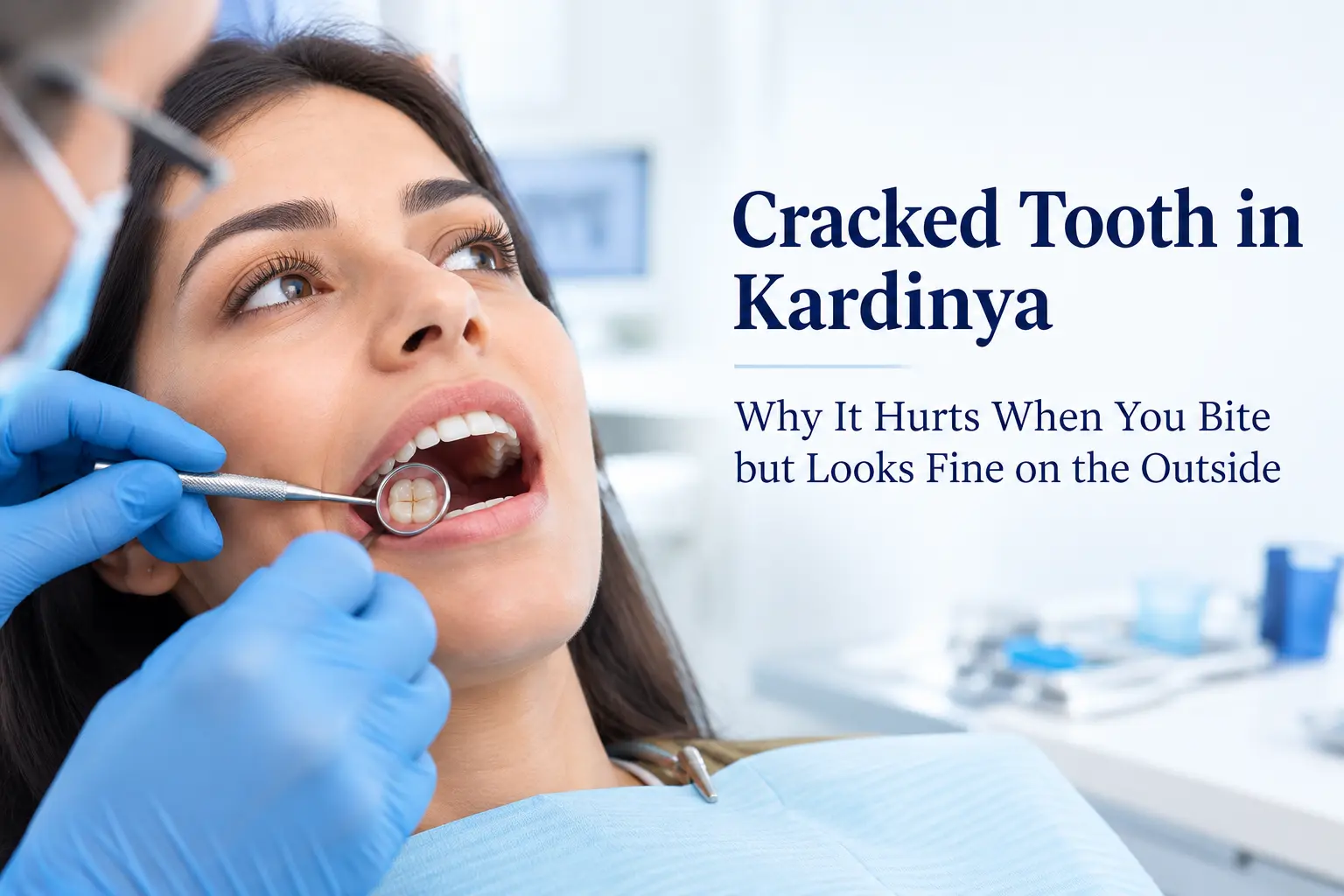
Diagnosis is methodical rather than mysterious. We take your history first, because the biting-release-erratic pattern tells half the story before we touch anything. Then the bite test: you bite on a small instrument cusp by cusp, and the crack identifies itself when the right spot fires. Magnification and strong transillumination, shining light through the tooth so a crack interrupts the glow, locate the line; sometimes a disclosing dye traces it. X-rays rule out the mimics. Most cracked teeth are identified in a single visit, and you leave knowing which rung of the ladder yours sits on, what fixing it costs with written item numbers for your health fund, and what waiting would risk. Crowns and root canal treatment sit in the major dental category of extras cover, and HICAPS claims are processed at reception on the spot. Kardinya is under ten minutes from the practice, which is a short drive to convert an unpredictable jolt back into a boring, reliable tooth.
Frequently Asked Questions
Why does my tooth hurt when I bite but look completely normal?
A hairline crack is likely flexing under bite pressure and snapping shut on release, firing the nerve each time. Most cracks are invisible to the eye and often to X-rays, so a normal appearance proves nothing; the biting-pain pattern itself is the key evidence.
Can a cracked tooth heal on its own?
No. Unlike bone, tooth structure cannot knit back together, and daily chewing progressively extends a crack. Early treatment usually means a crown; delay can add root canal treatment or end in extraction once the crack passes below the bone.
Why doesn’t a cracked tooth show on an X-ray?
Cracks usually run in a plane that standard X-ray beams pass along rather than across, so the fracture line leaves no shadow. Dentists diagnose cracks from the symptom pattern, bite tests, magnification, and transillumination instead, using X-rays mainly to rule out other causes.
How urgent is a suspected cracked tooth?
Book promptly, within days rather than months. Pain on biting alone is not a same-day emergency, but every week of chewing can deepen the crack and drop the tooth down the treatment ladder. Constant ache, swelling, or a bad taste upgrades it to a same-day emergency visit.
Let’s Find That Crack Before It Chooses for You
Bull Creek Dental, 1/79 Wheatley Dr, Bull Creek WA 6149, Australia | Get Directions
Phone: 08 9332 3608 | Book an Appointment | Contact Us
Open six days a week, with Thursday evening appointments, complimentary on-site parking, and on-the-spot HICAPS health fund claiming.