If the sound of the scaler is the part of your dental visit you dread most, there is genuinely good news. Airflow cleaning at Bull Creek Dental uses a controlled stream of warm water, air and an ultra-fine powder to lift plaque, biofilm and surface stains from your teeth — often with far less scraping, less sensitivity and less time in the chair than a traditional scale and polish alone.
Both approaches have their place, and the best professional clean often combines them. This guide explains exactly what changes when your dental check-up in Bull Creek includes EMS Airflow and Guided Biofilm Therapy, who benefits most, and the honest limits of what Airflow can and cannot do.
Want to try it at your next visit? Book your appointment today or call 08 9332 3608.
What Happens in a Traditional Scale and Polish?
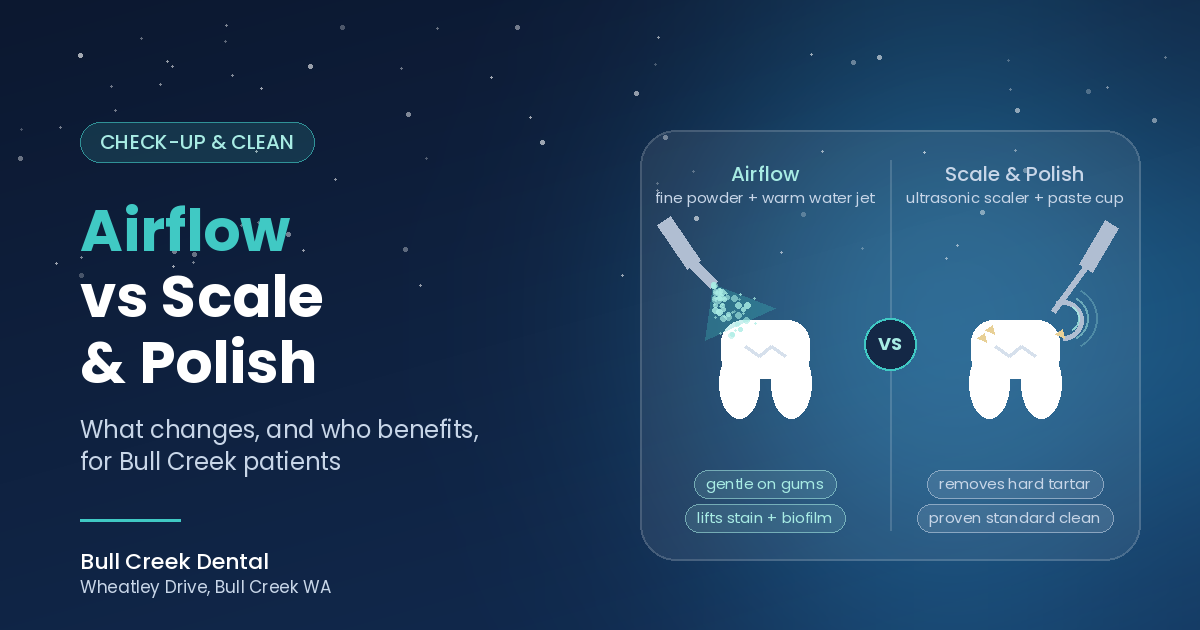
A traditional scale and clean uses an ultrasonic scaler and fine hand instruments to chip away calculus — the hardened tartar that forms when plaque is left on teeth — followed by a polish with a rotating rubber cup and gritty paste. It is effective and remains an essential tool, but for some patients the vibration, scraping sensation and cold water spray make it uncomfortable, especially around sensitive necks of teeth or receding gums.
What Changes With EMS Airflow?
EMS Airflow takes a different route to the same goal. Instead of relying mainly on mechanical scraping, it sprays a precise mixture of warm water, compressed air and a very fine, slightly sweet powder across the tooth surface. That jet flushes away plaque, soft biofilm and surface staining — including from places instruments struggle to reach, such as deep grooves, tight contacts between teeth, around orthodontic attachments and along the gum line.
At Bull Creek Dental, Airflow is used as part of Guided Biofilm Therapy (GBT) — a structured protocol where biofilm is first disclosed with a harmless dye so both you and your clinician can see precisely where it hides, then removed systematically. Only after the biofilm is gone do we use ultrasonic or hand scaling, and only where hardened calculus actually remains. The result is less instrumentation overall, not more.
Airflow vs Traditional Cleaning: The Practical Differences
- Comfort: warm water and no constant scraping make Airflow noticeably gentler — most patients describe it as a warm spray rather than a dental procedure.
- Sensitivity: because less pressure is applied to exposed root surfaces, patients with sensitive teeth usually find Airflow far easier to tolerate.
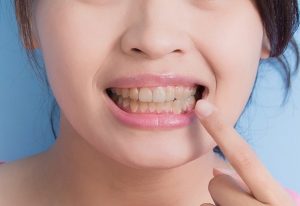
- Stain removal: the fine powder is excellent at lifting coffee, tea, red wine and tobacco staining that a rubber-cup polish can leave behind.
- Reach: the spray cleans around implants, crowns, bridges, veneers and Invisalign attachments without scratching them — areas where metal instruments must be used cautiously.
- Time: with biofilm removed first, the scaling stage is shorter and more targeted, so appointments often feel quicker.
Who Benefits Most From Airflow in Bull Creek?
Airflow suits almost everyone, but a few groups notice the biggest difference:
- Patients with sensitive teeth or dental anxiety who have put off cleans because of past discomfort
- Coffee and tea drinkers with stubborn surface staining they want lifted before an event or a whitening treatment
- People with implants, crowns, veneers or bridges — gentle biofilm removal helps protect the investment; you can read more on our dental implants page
- Invisalign and orthodontic patients whose attachments trap plaque in awkward spots
- Patients in gum disease maintenance, where thorough, regular biofilm removal is the treatment — see our gum disease treatment page
What a Guided Biofilm Therapy Appointment Looks Like
If you haven’t experienced GBT before, here’s the sequence your appointment follows:
- Assessment: we examine your teeth and gums and check probing depths, because the state of your gums determines how thorough the clean needs to be
- Disclosing: a coloured dye highlights every patch of biofilm — often eye-opening, because it shows exactly where your home brushing is missing
- Coaching: armed with that map, we give you targeted advice for the two or three spots your toothbrush keeps skipping — arguably the most valuable five minutes of the visit
- Airflow: the warm spray removes the disclosed biofilm and surface stain from teeth, gums, tongue and around any dental work
- Targeted scaling: ultrasonic or hand instruments are used only where hardened calculus remains — usually far less than a conventional appointment
- Final check: we confirm every surface is clean and, where appropriate, apply fluoride to finish
The powder itself deserves a mention: modern Airflow uses an ultra-fine erythritol-based powder — the same sweetener found in sugar-free products — which is gentle on enamel, dentine and gum tissue, mildly sweet rather than gritty, and suitable for children, older patients and almost everyone in between. Patients on low-salt diets or with specific medical conditions should mention it beforehand so we can select the most appropriate powder.
Does Airflow Replace Scaling Completely?
No — and any clinic that tells you otherwise is overselling. Airflow removes plaque, biofilm and stain brilliantly, but once plaque has mineralised into hard calculus, it still needs an ultrasonic scaler or hand instruments to remove. That is why Guided Biofilm Therapy sequences the two: Airflow first, targeted scaling second. You get the gentlest clean possible without compromising on thoroughness.
Does Airflow Whiten Your Teeth?
Airflow removes extrinsic staining — the discolouration sitting on the tooth surface — so teeth genuinely look brighter and closer to their natural shade straight after the appointment. It does not bleach the tooth itself. If you want to go lighter than your natural shade, professional whitening is the next step, and a stain-free surface from an Airflow clean is actually the ideal starting point for it.
How Often Should You Have a Professional Clean?
For most adults, every six months alongside your check-up — a rhythm supported by the Australian Dental Association’s oral health guidance. Patients with gum disease, heavy staining, orthodontic appliances or a history of rapid tartar build-up may benefit from three- to four-monthly visits. Healthdirect also notes that professional cleaning reaches what home brushing and flossing cannot — no matter how good your technique is.
We are open six days a week at 1/79 Wheatley Drive, Bull Creek, with complimentary parking at the door, and our team speaks English, Hindi, Punjabi and Urdu. Patients visit us from Leeming, Willetton, Brentwood, Bateman and across Perth’s southern suburbs.
Two timing tips worth knowing: if you’re planning professional whitening, book your Airflow clean first — whitening gel works far more evenly on a stain-free surface, so you get a better result from the same treatment. And if you have a wedding, reunion or photos coming up, a stain-lifting clean a few days beforehand is the quickest, safest brightness boost there is. New patients can also ask our reception team about the current new patient offer, which bundles the essentials of a first visit at a fixed price.
Ready for the most comfortable clean you’ve had? Book your appointment today, contact us online or call 08 9332 3608.
Frequently Asked Questions
What is Airflow teeth cleaning?
Airflow is a professional cleaning method that sprays warm water, air and a fine powder to remove plaque, biofilm and surface stains. At Bull Creek Dental, it is used within Guided Biofilm Therapy, followed by targeted scaling only where hardened calculus remains.
Does Airflow hurt less than a normal scale and clean?
Most patients find it significantly more comfortable. There is no continuous scraping, the water is warm rather than cold, and less pressure is placed on sensitive root surfaces — which is why it is often recommended for anxious or sensitive patients.
Will Airflow make my teeth whiter?
It restores your teeth to their natural shade by lifting coffee, tea, wine and tobacco staining from the surface. It does not bleach teeth — for a shade lighter than natural, professional whitening is the appropriate treatment.
Is Airflow safe for implants, crowns and veneers?
Yes. The fine powder cleans around implants and restorations without scratching them, which is one of the reasons Airflow is particularly recommended for patients maintaining dental work.