If your partner keeps nudging you awake, or you wake most mornings feeling like you barely slept, you have probably wondered whether snoring is something a dentist can actually fix. The short answer is yes — for many people. Snoring and sleep apnoea treatment in Bull Creek often involves a custom oral device called a mandibular advancement splint, fitted by a dentist and worn only while you sleep.
At Bull Creek Dental, we work alongside your GP and sleep physician to treat snoring and mild to moderate obstructive sleep apnoea (OSA) with custom-made oral appliances. In this guide, we explain how a mandibular advancement splint works, when a sleep study is needed, how it compares with CPAP, and what your health fund may cover — so you can make an informed decision, not a guess.
If you would rather talk it through in person, book your appointment today or call 08 9332 3608.
Can a Dentist Treat Sleep Apnoea?
Yes. Dentists can provide oral appliance therapy for snoring and mild to moderate obstructive sleep apnoea, usually after a diagnosis from a doctor or sleep physician. The dentist’s role is to design, fit and adjust a mandibular advancement splint (MAS) — a device that holds your lower jaw slightly forward during sleep to keep the airway open. Dentists do not diagnose sleep apnoea on their own; diagnosis comes from a sleep study, which is why we work as part of a team with your GP.
This team approach matters. Snoring is sometimes harmless noise, but it can also be a warning sign of OSA — a condition the Sleep Health Foundation links to daytime fatigue, high blood pressure, and cardiovascular risk when it goes untreated. Treating the sound without checking the cause can leave a serious condition hidden.
What Is a Mandibular Advancement Splint?
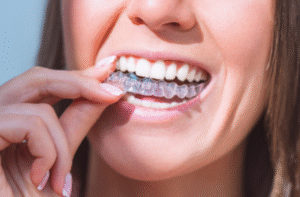
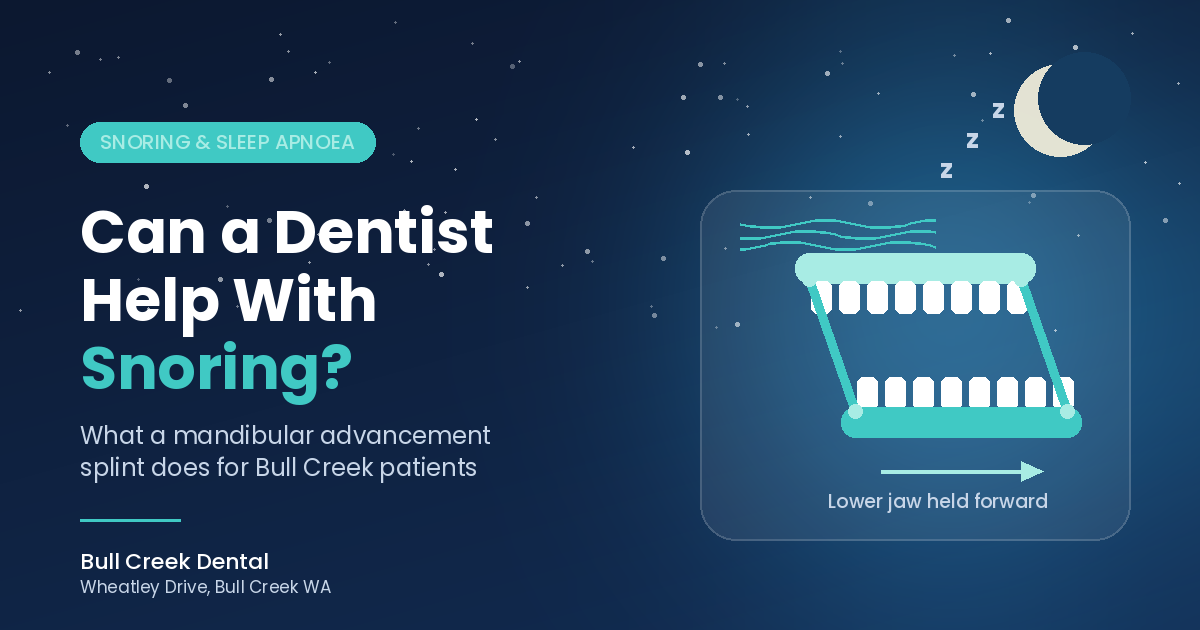
A mandibular advancement splint is a custom dental device for snoring and sleep apnoea, made from impressions or digital scans of your own teeth. It looks a little like two slim mouthguards that fit over your upper and lower teeth and connect so that your lower jaw sits a few millimetres forward while you sleep.
That small forward posture does three useful things:
- It pulls the base of the tongue away from the back of the throat
- It gently tensions the soft tissues of the airway so they vibrate less — which is what reduces the snoring sound
- It helps keep the airway open, reducing the breathing pauses that define obstructive sleep apnoea
Because every splint we fit in Bull Creek is custom-made, it can be titrated — adjusted in tiny increments over several weeks — until you reach the position that controls symptoms while staying comfortable. This is a key difference from one-size-fits-all anti-snoring devices sold online, which cannot be adjusted, often fit poorly, and are not designed around your bite.
Do You Need a Sleep Study Before Getting an Oral Appliance?
In most cases, yes — and a good dentist will insist on it. A sleep study is the only reliable way to know whether you simply snore or whether you have obstructive sleep apnoea, and how severe it is. That severity grade decides whether an oral appliance is the right first-line treatment or whether CPAP should be considered instead.
Here is what the pathway typically looks like for our Bull Creek patients:
- Step 1 — See your GP. They can refer you for a sleep study, which Healthdirect notes can often be done at home with portable monitoring equipment, or overnight in a sleep clinic.
- Step 2 — Get your results reviewed. A sleep physician grades your OSA as mild, moderate or severe, or confirms you are a primary snorer without apnoea.
- Step 3 — Splint fitting. If oral appliance therapy suits your result, we take precise records of your teeth and jaw position and have your splint custom-made.
- Step 4 — Titration and review. Over the following weeks, we fine-tune the jaw position, then review how your symptoms — and your partner’s sleep — have improved.
If you come to us first without a diagnosis, we will not simply sell you a device. We will assess your airway, teeth and jaw joints, then coordinate with your GP so treatment is based on real data.
Sleep Apnoea Mouthpiece vs CPAP: Which Works Better?
CPAP (continuous positive airway pressure) is the gold-standard treatment for severe obstructive sleep apnoea. On raw effectiveness per night of use, CPAP outperforms an oral appliance — it physically pressurises the airway open. So why do so many people end up in a splint instead?
Because a treatment only works if you actually use it. Many patients find the CPAP mask, hose and pump noise hard to tolerate every night, and abandoned CPAP delivers no benefit at all. A mandibular advancement splint is silent, needs no power, fits in your pocket when you travel, and most people adapt to it within a couple of weeks. For mild to moderate OSA, real-world results between the two are often closer than the lab numbers suggest — precisely because splint wearers tend to use their device more consistently.
A fair summary for anyone weighing up snoring treatment without CPAP:
- Severe OSA: CPAP first; a splint may be an option if you genuinely cannot tolerate CPAP, in consultation with your sleep physician
- Mild to moderate OSA: oral appliance therapy is a recognised first-line option
- Primary snoring (no apnoea): a custom splint is usually the most effective and least intrusive fix
Who Suits a Splint — and Who Doesn’t
Honesty here saves you money and frustration. An oral appliance is not right for everyone. You are generally a good candidate if you have enough healthy teeth to anchor the device, healthy gums, and mild to moderate OSA or primary snoring. A splint may not suit you if you have advanced gum disease, very few natural teeth, or an unstable jaw joint — and untreated TMJ symptoms need assessment before we advance the jaw every night. Part of your first visit at Bull Creek Dental is checking exactly these things, before any device is made.
Are Snoring Mouthguards Covered by Private Health Funds?
Often, partially — it depends on your fund and your level of extras or hospital cover. A custom mandibular advancement splint is a dental item, so many Australian health funds contribute a benefit towards it under major dental, though the rebate and any waiting periods vary between policies. Chemist-style boil-and-bite devices generally attract no rebate at all, which narrows the real price gap between a cheap generic device and a properly fitted one.
Our front desk team can give you the item numbers before treatment starts so you can phone your fund and confirm your exact rebate — no surprises. With HICAPS available at the practice, your claim is processed on the spot, and you only pay the gap.
What to Expect at Bull Creek Dental
We are located at 1/79 Wheatley Drive, Bull Creek, and see patients from Leeming, Willetton, Brentwood, Bateman and surrounding suburbs — open six days a week, including Saturdays, with evening appointments on Thursdays. Your splint journey with us involves an airway and dental assessment, coordination with your GP or sleep physician, precise records for a custom-made appliance, a careful fitting, and scheduled reviews while we titrate the device. Long after fitting, we keep an eye on the splint’s condition and your symptoms at your regular check-ups.
Snoring is easy to laugh off. Broken sleep, morning headaches and a tired partner are not. If any of this sounds familiar, book your appointment today, contact us online or call 08 9332 3608 — and find out whether a small, silent device could be the reason you finally wake up rested.
Frequently Asked Questions
Can a dentist treat sleep apnoea?
Yes — dentists provide oral appliance therapy for snoring and mild to moderate obstructive sleep apnoea using a custom mandibular advancement splint, usually after a sleep study confirms the diagnosis. Severe cases are managed with a sleep physician, where CPAP is typically the first recommendation.
Does a mandibular advancement splint work as well as CPAP?
For severe sleep apnoea, CPAP remains more effective. For mild to moderate cases, a custom splint is a recognised alternative, and because people tend to wear a splint more consistently than a CPAP mask, real-world outcomes are often comparable.
Do you need a sleep study before getting an oral appliance?
Yes, in almost all cases. A sleep study — often done at home — confirms whether you have sleep apnoea and how severe it is, which determines whether a splint is a safe and appropriate treatment for you.
Are snoring mouthguards covered by private health funds?
Many Australian health funds pay a benefit towards a custom-fitted mandibular advancement splint under dental cover, though rebates vary by policy. We can supply the item numbers in advance so you can confirm your rebate, and HICAPS lets you claim on the spot.